Here’s another transcription from Kellner’s book of Selected Lute Pieces, 1747.
This Phantasia is the first piece in the book, and it makes for a great opening. It also translates beautifully to the guitar!
For some background on Kellner and the book, see also my earlier post on the Passepied.
The form
Phantasias/Fantasias are typically loose and quasi-improvisational in form, without any real expectations for their structure or internal modulations. They’re more like free explorations within a key, with occasional temporary departures into related keys. Kind of like a Prelude in Bach’s terminology, but without any accompanying fugue or any role within a larger form.
This example breaks down into three main chunks: a spacious intro that sets up the A minor key and finishes on a half-cadence on the dominant E major; a dense and fast middle section that explores some interesting harmonic territory with tasty implied chromatic lines; and an outro with similar qualities to the intro.
The intro and outro both feature arpeggiated chord forms that alternate between A minor and E major, with one important difference between the mirrored passages: the intro places those chord forms over an A pedal (that is, a repeated A note in the bass) and the outro places them over an E pedal before finally culminating on a resolution to A.
Compositionally speaking, exchanging those chords over the A bass in the first section has the effect of settling the listener in to the primary key center of A minor. Over the E in the third section, the effect is to extend the final cadence, building extra tension before the final resolution to A. And hey, we guitarists are never happier than when we get to play lots of As and Es in the bass!
Something my first guitar teacher used to say that always stuck with me was, “Never play the same thing the same way twice in a row. When you repeat a passage, let its character be changed by the music that came in between.” That’s kind of the way this mirroring between the first and third sections feels to me.
Adapting from lute to guitar
One of the things that really stands out to me in this piece is that it’s littered with chains of short-but-beautiful suspensions. I made a conscious effort in coming up with the fingerings to find ways to bring these suspensions out, even when it adds a little difficulty or inconvenience for the player.
We see one of those suspension sequences right at the start of the first section, in measure 2, with two parallel melodies that descend in alternation. Guitar players are used to shifting chord shapes: put your left-hand fingers in a shape, play some notes, shift the shape, play some more notes, shift the shape again (like the alternating A minor and E major chords I mentioned previously). But a passage like this needs to be approached differently: as two continuous and unbroken lines, where each note has to be held for its full value before connecting to the next. That means each melodic change in each of the two parts has to be fingered separately. Trying to move from one chord shape to another at any point will release all the fingers, thus breaking both lines at the same time, and also breaking the continuity of the chain of suspensions. Luckily, interspersed open strings allow chances for the left hand to reset to new positions.

[Images from IMSLP, public domain.]
The first section ends with a scale that runs up and down on top of an F major chord. In the original tablature, it’s underlined with a long, wavy line (you can see it at the end of the image above), which I interpret as an instruction to play it freely and with an improvisational flavor, like a really long connected slur. This is one of the few places in this piece where it’s hard to translate the lute’s low open strings to the guitar: it’s really difficult to play this scale smoothly and freely while also holding the low F in the one place it’s available on the guitar. You could let go of the F partway through the scale, but instead I chose to raise the bass up an octave, and to play in a higher position up the neck. This lets the player intersperse the open B and high E strings into the scale, making it almost into an arpeggio. The ringing open strings add an interesting flavor (one that is arguably not idiomatic for Baroque plucked string performance practice, but hey, this is an arrangement for modern guitar), and they make it easier to play the scale smoothly at speed while holding the bass note (at least for me).

The second section is my favorite part. It’s a fast-moving series of arpeggios where individual voices emerge here and there from the harmonic texture, like the chromatically rising melody notes at the beginning. Earlier in his life, Kellner wrote a how-to manual on “basso continuo” — that is, music theory focused on harmony, improvised accompaniment, and voice-leading. While I haven’t read the treatise (no German), this section of the Phantasia is so dense with really interesting harmonic changes, I feel it to be another illustration of how much thought and care he put into constructing novel harmonic progressions.
On guitar, the fingering throughout this section feels like taking common chord forms and layering unusual bits of chromatic flair and little micro-suspensions on top of them, or playing those common forms with unusual fingerings that help connect more smoothly to the chords before and after. At first, it’s a little mind-bending, but eventually the logic of the chain becomes clear and the passage becomes a real delight to play.
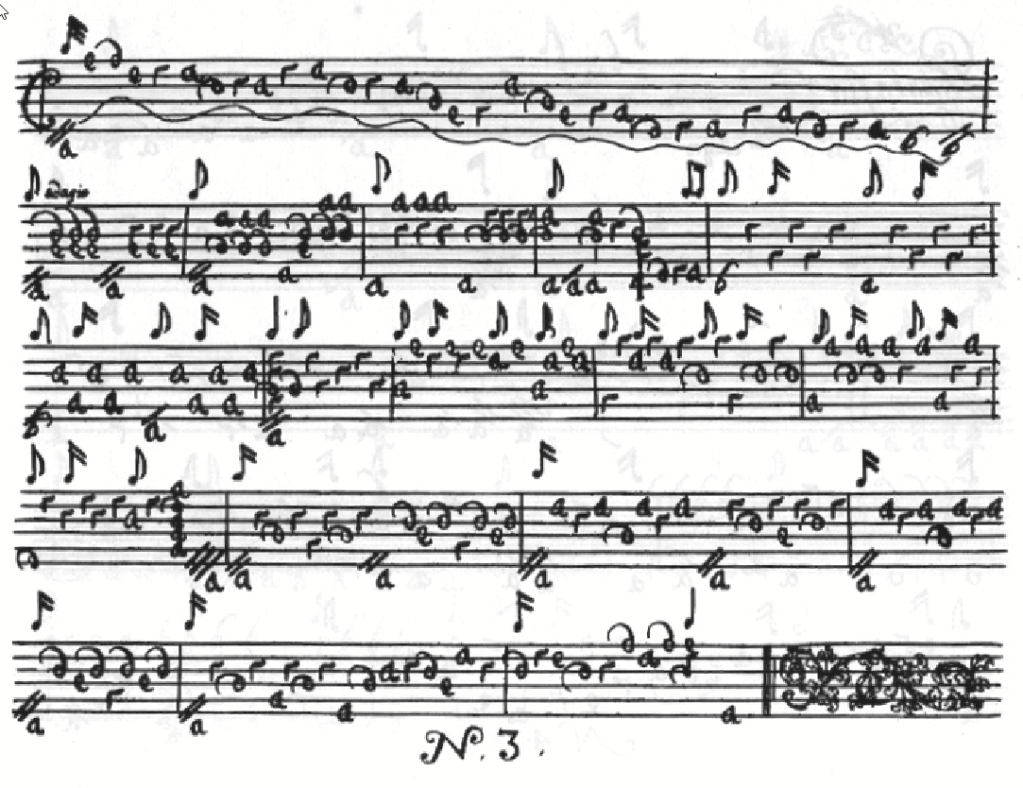
Like the first section, the second ends with a long, wavy, underlined scalewise passage, this time emphasizing the dominant chord of E major. It then takes a quieter turn with an adagio chordal section, a short trip into to C major, and another luscious sequence of suspensions before ramping up by restating the alternating E major and A minor arpeggio patterns from the first section, and finally ending with a quick rising passage over A minor that recalls the ending of Bach’s BWV 999 (another guitar favorite).
Download
You can download my arrangement here:
It contains notes and tablature in standard tuning.
Good luck! If you try it out, I’d love to hear your thoughts and feedback.

 Guitar Pieces
Leave a comment