Guitar Pieces

Musical works arranged with style for the modern guitarist.

Category: 1700-1750

  • Here’s another transcription from Kellner’s book of Selected Lute Pieces, 1747.

    This Phantasia is the first piece in the book, and it makes for a great opening. It also translates beautifully to the guitar!

    For some background on Kellner and the book, see also my earlier post on the Passepied.

    The form

    Phantasias/Fantasias are typically loose and quasi-improvisational in form, without any real expectations for their structure or internal modulations. They’re more like free explorations within a key, with occasional temporary departures into related keys. Kind of like a Prelude in Bach’s terminology, but without any accompanying fugue or any role within a larger form.

    This example breaks down into three main chunks: a spacious intro that sets up the A minor key and finishes on a half-cadence on the dominant E major; a dense and fast middle section that explores some interesting harmonic territory with tasty implied chromatic lines; and an outro with similar qualities to the intro.

    Read more and get the sheet music!
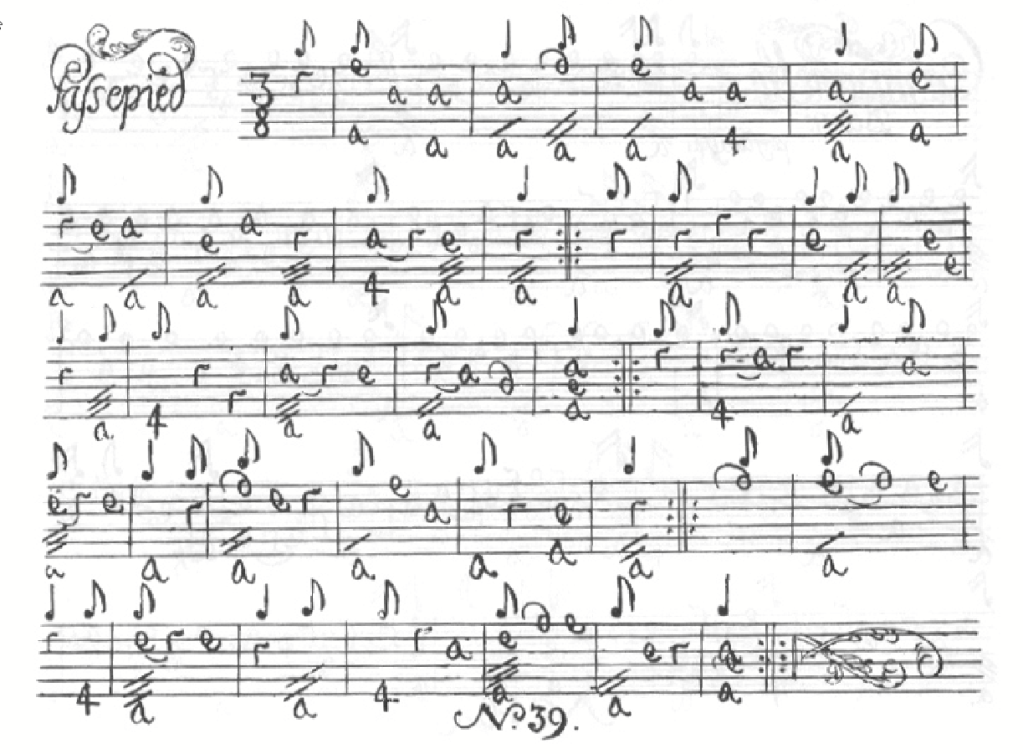
  • Here’s a charming little piece, originally written for the lute, that I’ve adapted for guitar.

    Passepied by David Kellner, reproduction from the original.

    [Image from IMSLP, public domain.]

    The source

    This piece comes from a book published in 1747, entitled David Kellners XVI. Auserlesene Lauten-stücke, or Selected Lute Works. It was written by David Kellner, a German composer who lived most of his professional life in Sweden working as a church organist.

    The title is a little funny, because there appear to be 17 separate compositions in there, even if we count the Sarabanda and Double on page 44 together as one. There’s an anonymous suggestion on IMSLP that the XVI is intended to mean that it’s Kellner’s sixteenth work, which is possible but hard to verify based on what’s known of his written output. His life story isn’t germane to this piece, but you can read more about him here if you’re curious.

    There don’t seem to be any other records from Kellner’s lifetime that refer to him playing the lute. So, either this was a talent of his that wasn’t as much in the public eye as his organ playing, or it could be that he wrote the material on keyboard and fingered it for the lute for publication. Though that seems unlikely to have been a winning sales idea, as 1747 is at the tail end of the lute’s era of prominence.

    The book contains mostly short pieces in traditional dance forms, with a few loose fantasias, and one really long Chaconne. I’m enjoying getting to know them. I hope to share more of them over time, because the guitar could use more characteristically Baroque repertoire, from a wider variety of composers, that isn’t as intense and hard to play as some of the usual suspects.

    read more and get the sheet music!